ⓘ Community Research – Not an Official Document
This is a community-sourced compilation. I'm an EV6 owner, not an EV technician – I'm using the tools I have to better understand this issue and sort what's real from what's not. You should view this with the same skepticism you'd apply to any forum, Reddit, or Facebook post.
The information here is gathered from NHTSA filings, teardown videos, forum threads, and community discussion, then verified where possible against service manual data and professional analysis. Any mitigation strategies discussed should be considered speculative without further guidance from Hyundai Motor Group – use your own judgement based on the information provided. Claims are labeled by confidence level throughout. If you spot an error, let me know – corrections are tracked and published in the changelog. This page is current as of mid-September 2026.
Why this page exists – a note from the editor
The E-GMP community strongly suspects the instances of ICCU failure in this platform's variants are higher than the 1% that Hyundai Motor Group claims, and in absence of direct communication to consumers, like other enthusiasts who love this platform I wanted to try to piece together the real story and see if I could mitigate the risk with my own car.
This page is the result – a report gleaned by AI research tools from findings scattered across forums, NHTSA filings, teardown videos, and community threads. New info is analyzed for accuracy, plausibility in connection with the issue, and integrated into the complete story where it fits best. Every claim is labeled by confidence level – established fact, plausible, or anecdotal – so you always know how solid the evidence is behind what you're reading. Sources are cited inline where appropriate and compiled at the end of the report. I've been adding to it with every new piece of information that comes out, and I'll keep doing so in case it's useful to anyone else considering these cars.
It's likely the manufacturer knows what's going on with these failures, but from every indication we have, it seems like there is also no single cause, and perhaps therefore, no single fix that would address each cause of failure. As of May 2026, there are a few hints that a revised part may permanently fix the issue, but we still don't know if the revised part is a complete redesign, a refresh, the same part with more robust components, or simply a different revision letter on essentially the same hardware.
If it is a part known to eliminate the causes of the failures, I hope Hyundai, Kia, and Genesis will do the right thing and recall every affected vehicle. This would be a significant campaign, but not unprecedented – Toyota is dealing with an even more extensive recall with their Tundras right now (manufacturing debris in engines). Recalling all E-GMP vehicles to resolve this ICCU issue permanently would restore a whole lot of trust in the manufacturer, and create tremendous goodwill amongst owners, not to mention provide confidence to those purchasing these vehicles second hand. These cars are just too good to be defined by such a persistent flaw.
Just an added FWIW: I've owned a brand-new ICE vehicle that shut down in the middle of the road before – a first-year refresh 2014 Jeep Grand Cherokee where they'd changed a lot under the skin. When it shut down, it really shut down – engine dead, power steering gone, no hazards, on a dark road. The car was just totally dead. I know what that's like. The ICCU issue is not that – the car warns you well in advance, and you aren't left without power steering or hazard lights. Yeah, it sucks, and yeah, you're at the mercy of your dealer and how good or bad they are. But as Hyundai Motor Group gets a handle on this issue, hopefully they will make good on it for all of us E-GMP fans and owners.
1. What Is the ICCU?
The Integrated Charging Control Unit is a fluid-cooled aluminum housing containing the electronic components, located beneath the rear seats on all Hyundai/Kia/Genesis vehicles built on the E-GMP platform. It contains two power conversion subsystems:
- LDC – Low-Voltage DC-DC Converter. Steps the high-voltage battery (400–800V) down to 12V. It's the EV's alternator – every 12V system in the car depends on it. Max output is approximately 1.8 kW.
- OBC – On-Board Charger. Converts external AC power to DC for charging the high-voltage battery (Level 1 and Level 2 charging, up to 10.9 kW). The OBC is bidirectional – it also operates in reverse to convert DC back to AC for V2L (Vehicle-to-Load) power export, up to 3.68 kW.
A note on "OBC" terminology: Hyundai/Kia documentation uses "OBC" inconsistently – sometimes referring to the AC-DC rectifier circuit specifically, sometimes to the entire ICCU assembly. On this page, "OBC" always means the AC-DC rectifier circuit inside the ICCU – the component that converts AC power to DC for Level 1/Level 2 charging. The ICCU is the physical unit; the OBC is one of the two power conversion circuits inside it.
Charging communication (coordinating with the BMS and external chargers via ISO 15118) is handled by the VCMS (Vehicle Charge Management System), a separate control module. V2L (Vehicle-to-Load) runs the OBC in reverse to export AC power – the power conversion happens inside the ICCU, but the outlet relay and socket hardware are a separate V2L module. Neither the VCMS nor V2L is involved in the failure modes discussed here.
Important clarification: During DC fast charging (Level 3), the high-power DC path goes directly from the charge port to the HV battery, bypassing the ICCU's power electronics entirely. For 800V DCFC, power flows through contactors straight to the battery pack. For 400V DCFC, the rear motor inverter acts as a boost converter to step up to 800V. The ICCU's OBC and LDC are not in the DCFC power path – though the LDC continues running in the background to keep the 12V system alive during a DCFC session.
2. What Actually Fails and Why
Two of the ICCU's subsystems can fail independently, and you'll see these abbreviations throughout this page:
- LDC – Low-Voltage DC-DC Converter. Steps high-voltage battery power down to 12V. It's the alternator replacement. If it dies, the 12V battery drains and the car stalls.
- OBC – On-Board Charger. Converts external AC power to DC for charging. If it dies, the car drives fine but can't charge from Level 1 or Level 2, and it may damage your EVSE or trip your breakers in the process.
The LDC failure is far more common, and more critical, so the bulk of this page focuses on it. OBC-specific information is called out in amber-highlighted sections like the ones you'll see below.
The converter design: why transients are inherent
The short version: a MOSFET (a type of power transistor) inside the LDC gradually degrades until it short-circuits. MOSFETs are ubiquitous in power electronics – they're in everything from phone chargers to solar inverters – and MOSFET degradation under sustained switching stress is a well-understood failure mode in the industry. The E-GMP ICCU operates at the intersection of 800V-class voltage, SiC semiconductor switching, and a ~300 kHz operating frequency – a combination that creates significant stress on internal components. That short draws massive current from the high-voltage battery, so the 130-amp internal fuse blows to prevent further damage. With the fuse blown, the entire ICCU loses its connection to the HV battery – the LDC can't convert HV power to 12V, and the OBC can't accept AC charging either. The 12V battery drains with no way to recharge. Here's why the MOSFET degrades in the first place.
The LDC uses a single-switch forward converter with active clamp topology. This isn't just jargon – it's central to understanding why the transients exist. In this design, the active clamp circuit resets the transformer's magnetic core after each switching cycle. The MOSFET that operates this clamp is the component that fails. The MOSFET switches at hundreds of thousands of times per second – the goingelectric.de teardown analysis identified a switching frequency of approximately 300 kHz. Each cycle produces a voltage transient as part of normal operation. The problem isn't that something goes wrong – it's that these normal operating transients, repeated hundreds of millions of times per day for the entire life of the vehicle, gradually destroy the component.
Two stressors are officially identified:
- Overvoltage spikes – the active clamp MOSFET experiences a voltage transient on every switching cycle (~300 kHz), and additional stress each time the LDC ramps up or down in response to 12V demand. Over hundreds of millions of cumulative cycles per day, these transients damage the MOSFET.
- Thermal cycling – the ICCU heats up during charging and driving, then cools down. This repeated heating and cooling degrades internal components over time.
Source attribution: How specific is the official documentation?
- NHTSA 24V-868 (Hyundai recall) identifies the failed component as a "MOSFET" and describes the cause as "transient high voltage and thermal cycling." This is the most specific official language.
- NHTSA 24V-867 (Kia recall) uses only general language: "ICCU may become damaged."
- A professional teardown by LTEC Corporation confirms STMicroelectronics SiC (silicon carbide) MOSFETs in the DCDC converter section.
- A community teardown by chris_11 on goingelectric.de, analyzing approximately 300 ICCU failures, identifies the specific part as the SCT1000N170 – an STMicroelectronics 1,700V SiC MOSFET used in the LDC's active clamp forward converter, switching at approximately 300 kHz.
- Neither NHTSA nor Kia/Hyundai has officially identified the semiconductor material (SiC) or the specific part number.
The other failure mode: OBC failure
The MOSFET/LDC failure described above is the most commonly reported – and the more critical of the two, since it eventually kills the car's ability to drive. But the LDC and OBC are independent of each other, and either can fail on its own. When the OBC fails, it produces a completely different set of symptoms.
When the OBC fails:
- Level 1 and Level 2 (AC) charging stops working entirely. The OBC converts external AC power to DC – if it's dead, no AC charging is possible.
- DC fast charging (Level 3) still works. A DC fast charger supplies DC power directly to the high-voltage battery, bypassing the OBC completely. The OBC is simply not in the DC power path.
- The car drives normally. The LDC is still functioning, so the 12V battery stays charged and all vehicle systems operate as expected.
- The EVSE (charging station) may be damaged. Multiple owners have reported that an OBC failure caused their home EVSE to trip its breaker, trip the house circuit breaker, or in at least one case, destroy the EVSE entirely. One EV6 owner reported that charging knocked out power to their entire house – both the sub-panel circuit and the upstream main breaker tripped.
This failure mode is less commonly discussed because it's less dramatic – the car still drives and charges at DCFC stations – but the potential for EVSE and electrical panel damage makes it a serious concern. If you suspect an OBC failure, do not continue attempting to AC charge. Each attempt risks further damage to your EVSE, your electrical panel, or both. Use DC fast charging as a stopgap until the ICCU is replaced. The ICCU must be replaced regardless of which side fails.
A February 2026 Ioniq 5 repair order provides the first quantitative diagnostic measurements we've seen for an OBC failure. The dealer measured capacitance across Line and Neutral at the ICCU's AC input:
| Failed ICCU (L&N capacitance) | 152.6 nF |
| Factory spec | 23 nF |
| Known-good Ioniq 5 (reference) | 27 nF |
| L&N resistance (cable unplugged) | 19.21 kΩ |
The failed unit measured 6.6× over spec on capacitance – the dealer confirmed “bad ICCU and fuse” and replaced both: ICCU assembly (36400-1XAA0-A) and HV fuse (375F2-GI040), all under warranty at $0. The charging cable was tested and confirmed good.
Dealer repair order – Source: Roscoe P. Coltraine (Facebook – and almost certainly not his real name), shared Feb 2026. Repair order details redacted for privacy.
A March 2026 reader report describes a failure pattern that doesn't cleanly match either the pure OBC or pure LDC modes documented above. The vehicle is a 2022 Ioniq 5 SEL RWD (Feb 2022 build, 55,387 miles). While connected to an Emporia L2 EVSE, the owner cycled the breaker to reset the charger. When power returned, there was a loud pop from the car, which then reported that charging had failed. AC charging was completely dead from that point forward.
The dealer scanned DTC P1E011C – an OBC-side fault code indicating a PFC (Power Factor Correction) voltage sensor failure (see DTC table in Section 4). The dealer followed the “ICCU Fix It Right” diagnostic procedure and recommended ICCU replacement due to internal failure. The replacement part was 36400-1XAA0, installed under warranty.
What makes this case unusual: the 12V battery was also not being maintained – an LDC function – but the car produced none of the expected dashboard warnings. No “Check electric vehicle system,” no “Stop vehicle and check power supply,” no power limiting, no limp mode. The car drove normally on the freeway (65–70 mph, 17 miles each way to the dealer) with no indication of any problem. The owner only discovered the 12V drain through independent online research, then used a NOCO GENIUS5 maintainer to keep the 12V battery alive while waiting for the replacement part.
The dealer's repair order also did not flag the 12V issue. Whether the LDC had partially failed alongside the OBC, or whether the 12V drain was a secondary effect of the OBC fault, is unclear from the available data.
Single report – Source: Joey R. (reader submission, Mar 2026). Personal details redacted.
Sources: KiaEVForums – A Different ICCU Failure • KiaEVForums – Lev 1 and Lev 2 Charge Failure • IoniqForum – Is the Replacement ICCU Any Better? • BobIsTheOilGuy – ICCU Issues
At least one EV6 owner has reported an OBC failure with a twist: AC charging (L1/L2) is dead, the 12V battery still charges normally (LDC is fine), but DC fast charging starts and then cuts out after roughly 2 minutes. This doesn't match a pure OBC failure, where DCFC should work normally since the DC power path bypasses the OBC entirely.
The cause is unknown. In the vast majority of reported OBC failures, DCFC continues to work fine – owners routinely use DCFC as a stopgap while waiting for ICCU replacement. Why this owner's DCFC also failed is unclear. Possibilities include a fault code from the failed OBC triggering the BMS to restrict all charging, broader ICCU degradation affecting control logic, or an unrelated DCFC issue coinciding with the OBC failure. Without diagnostic data, we can't distinguish between these.
This matters because owners with an OBC failure are typically advised to use DCFC as a stopgap until the ICCU is replaced. If DCFC is also compromised, the vehicle may have no viable charging option while awaiting service.
A second report, September 2026. Sham wrote in about his 2026 EV6 Wind AWD, which stopped Level 1 charging overnight at just 1,135 miles. It wouldn't DC fast charge either. That's two things a straightforward OBC failure shouldn't do: a 2026 car isn't supposed to have the old ICCU, and DCFC bypasses the OBC. The dealer replaced the ICCU, and L1/L2 AC charging works again. He hasn't retested DC fast charging yet, so whether the replacement also fixed DCFC, or whether something else was going on with this car, is still open. Thanks to Sham for the report.
Two reports – Sources: r/KiaEV6 (Feb 2026); reader report (Sep 2026). If you've experienced this pattern, please reach out so we can document it further.
3. Why This Is Progressive Degradation, Not a Sudden Event
This is a critical point that's often misunderstood: the MOSFET doesn't go from healthy to dead in one bad spike. It degrades gradually over months or years through well-documented failure modes specific to SiC power semiconductors. The day it finally dies is just the day the last transient pushed an already-failing component past its threshold.
How the MOSFET degrades over time
| Degradation mechanism | What happens | Evidence |
|---|---|---|
| Gate oxide degradation | SiC gate oxides have roughly 100× higher interface defect density and a lower barrier height than silicon, making them inherently more susceptible to cumulative stress. Each overvoltage transient contributes to oxide wear. | Well-documented – OSU SiC Reliability Lab |
| Threshold voltage drift | Charge trapping at the SiC/SiO2 interface causes the MOSFET's switching threshold to shift over time. It starts switching incompletely or at the wrong times, generating excess heat. | Well-documented |
| On-resistance creep | A degrading MOSFET conducts less efficiently. Higher resistance means more heat, which means faster degradation – a positive feedback loop. Documented at both the semiconductor level (from threshold drift) and the packaging level (from bond wire degradation). | Well-documented |
| Bond wire & die attach fatigue | Thermal cycling (repeated heating and cooling during normal operation) mechanically stresses the internal wire bonds and solder joints. Micro-cracks form and propagate. This is the primary packaging-level failure mode. | Well-documented |
For context on how little margin exists: at 800V, a short-circuit event takes approximately 2–5 microseconds to damage a SiC MOSFET (compared to roughly 10–20 microseconds for a traditional silicon IGBT). As the component degrades, transients that a fresh MOSFET would handle without issue become fatal.
LDC charging behavior: the transients aren't gentle
Community monitoring data (via OBD tools like Car Scanner) reveals that the LDC doesn't always charge the 12V battery gently:
- When the 12V battery SOC drops below approximately 90%, the LDC can dump over 40 amps into it to bring it back up. For context, a healthy steady-state charging current is in the 6–12A range. These high-current events mean the LDC is ramping hard and frequently – each ramp producing the overvoltage transient that damages the clamp MOSFET.
- ECO mode potentially impacts 12V charging as well. OBD monitoring by a forum member shows that in ECO mode, the 12V charging current goes negative during acceleration (the 12V battery drains faster than the LDC supplies) and then spikes positive during regenerative braking. Switching to Sport mode kept current positive and noticeably higher. This creates constant voltage oscillations in ECO – effectively maximizing the number of damaging transient events per drive. Community-verified via OBD
Both of these behaviors are independently verifiable by any owner with a Bluetooth OBD adapter and the Car Scanner app (or similar). They illustrate that the LDC's daily operating life is significantly more stressful than a simple "convert 800V to 12V" description suggests.
4. How to Recognize an ICCU Failure
When the MOSFET fails and the internal fuse blows, the 12V battery loses its only charging source. Symptoms typically appear in this order:
- An audible pop or clunk from beneath the rear seats (likely the internal fuse blowing)
- "Check electric vehicle system" warning on the dashboard
- "Stop vehicle and check power supply"
- "Power Limited" warning – the car begins limiting performance
- Over the next 20–45 minutes, 12V systems progressively fail as the battery drains
- Eventually the car shuts down completely and cannot be restarted
Other signs that may indicate ICCU degradation before a full failure:
- 12V battery repeatedly dying or needing jump-starts
- LDC output voltage dropping below ~13.5V (check with Car Scanner app or similar OBD tool)
- DTC P1A9096 stored in the system
Known ICCU diagnostic trouble codes
The following DTCs are associated with ICCU failures and may trigger inspection or replacement under Kia TSB SC302 / Hyundai Recall 257:
The four OBC-side codes (P1E011C, P1E0211, P1E1300, P1E0C73) relate to the PFC (Power Factor Correction) stage of the on-board charger – the first conversion stage that takes AC input and outputs DC to the rest of the charging circuit. PFC stands for Power Factor Correction: it aligns the voltage and current phases during AC charging to minimize impact to the AC grid. The PFC voltage sensor monitors the output of this stage, and if it fails its reliability or calibration check, the ICCU disables AC charging. These codes are documented in Kia TSB SC302 as triggers for ICCU inspection and potential replacement.
If your car drives fine but won't accept an AC charge (Level 1 or Level 2) from any source, this may be an OBC failure rather than the LDC failure described above. Key differences: the car still drives normally, DC fast charging still works, but attempting to AC charge may trip your EVSE breaker or house breaker. Don't keep trying to charge – repeated attempts through a failing OBC can damage or destroy the EVSE. Have the ICCU inspected. See Section 2 for a full comparison of the two failure modes.
How much time you have depends on the state of your 12V battery, ambient temperature, and how many accessories are drawing power. A healthy 12V battery in moderate conditions gives you 20–45 minutes. Even in a worst case – weak battery, freezing cold, heavy accessory load – you will still have at minimum a few minutes of warnings, dashboard alerts, and reduced-power driving before the car stops. That is enough time to signal, slow down, and get to the shoulder.
This is fundamentally different from a catastrophic engine or electrical failure in a conventional vehicle, where loss of power can mean immediate loss of power steering, power brakes, and all electrical systems simultaneously with no buffer and no warning. The ICCU failure mode is progressive, not instantaneous. The danger is not the failure itself – it's ignoring the warnings and continuing to drive until the 12V battery is fully depleted, at which point you lose lights, hazard flashers, and propulsion.
In one specific case sent in by a reader (2022 Ioniq 5, DTC P1E011C), the OBC failed and the 12V battery was not being maintained – but the car produced no dashboard warnings whatsoever. No “Check electric vehicle system,” no “Stop vehicle and check power supply,” no power limiting. The car drove normally on the freeway with no indication of any problem. The owner only discovered the 12V drain through independently checking after doing their own online research. The dealership did not flag the 12V issue either.
This is a single report and may not be representative, but it makes an important point: if your AC charging has failed, do not assume the 12V battery is fine just because the dashboard says nothing. Check it independently with a multimeter or OBD tool. See the OBC + Silent LDC Failure column in the Section 2 comparison table for full details.
5. The "Cold Morning Reverse" Pattern
A recurring pattern in community reports: ICCU failures happening in the morning, within the first few miles from home, often while backing out of the driveway. The typical scenario: the car charged overnight, the owner turns on heated seats and the heated steering wheel, shifts into reverse, and hears a pop.
This isn't coincidence. This scenario stacks every electrical stressor simultaneously.
What happens when you shift into reverse
Multiple 12V subsystems activate at once:
- Surround view / rear camera system (cameras + image processing)
- Parking sensors (ultrasonics)
- Reverse lights
- Infotainment display switches to camera mode
- Electric parking brake may release (if auto-hold was engaged)
Each is a modest individual draw, but they all hit the 12V bus simultaneously – a step-change in demand that the LDC must respond to by ramping its output.
Important note: Heated seats and the heated steering wheel run on the 12V system, not the high-voltage battery directly (confirmed by fuse box diagrams – 20A front seat heater fuse, 25A rear – and OEM parts listings). Owner measurements show approximately 70W per seat on high and ~70W for the heated steering wheel. With both front seats and steering wheel on, that's roughly 210W of continuous load on the LDC on top of everything else.
Why this scenario stacks the risk
| Factor | What it does |
|---|---|
| Post-charging thermal stress | The ICCU just spent hours running the OBC, generating heat and thermally cycling its components. |
| Heavy baseline 12V draw | Heated seats (~70W per seat on high) + heated steering wheel (~70W) are already pulling ~210W from the LDC before you even move. |
| Cold ambient temperature | The 12V lead-acid battery has higher internal resistance when cold, forcing the LDC to work harder to push current into it. |
| Sudden additional demand | Reverse shift activates cameras, sensors, lights, and display simultaneously – a load spike on top of the existing high draw. |
| LDC must ramp output quickly | This ramp creates exactly the type of overvoltage transient that damages the MOSFET. On an already-degraded component, this is the transient that pushes it over the edge. |
Evidence strength
- The ICCU design defect and overvoltage mechanism: Confirmed (NHTSA recalls, manufacturer acknowledgment)
- The heated-accessories-plus-reverse trigger: Mechanistically plausible – consistent with the confirmed failure mode, frequently reported on forums, but not documented in any TSB or engineering analysis
- The morning/post-charging timing: Anecdotal pattern – common in forum reports but not formally studied
6. Other Suspected Triggers
Beyond the cold-morning pattern, community members have identified several other conditions they believe contribute to ICCU stress. None of these are confirmed by the manufacturer, but they are consistent with the known failure mechanism.
| Theory | Detail | Plausibility |
|---|---|---|
| Dirty or unstable AC power | Voltage sags, spikes, and brownouts during home charging stress the ICCU's AC-DC conversion. Older homes, non-dedicated circuits, and unstable grid areas are frequently cited. | Plausible |
| Power surges through EVSE | Grid-side voltage spikes reaching the car's charging system. At least one owner reported their ICCU failure coincided with a power outage to their entire house during charging. | Plausible |
| Unstable DCFC stations | Some DC fast chargers deliver inconsistent voltage. The DCFC power path bypasses the ICCU's power electronics, so this wouldn't directly stress the OBC or LDC. However, the LDC continues running during DCFC sessions to maintain the 12V system, and electrical noise or ground-level shifts from an unstable charger could indirectly affect LDC operating conditions. | Speculative |
| Weak or degraded 12V battery | A battery that can't hold charge forces the LDC to cycle more frequently, with harder on/off transients each time – directly accelerating the degradation mechanism. | Plausible |
| Thermal soak | AC charging immediately after sustained hard driving in hot weather, while the ICCU is already heat-soaked, reduces thermal margins for the MOSFET. (DC fast charging bypasses the ICCU entirely.) | Plausible |
| Remote climate start | Using Kia Connect (or Bluelink for Hyundai) to remotely start the cabin climate before getting in the car. The ICCU is already under heavy 12V load – cabin fan, heated seats/steering if pre-set, infotainment – before the driver even starts driving. At least one owner reported failure immediately after a remote climate start on a cold morning. | Anecdotal |
| Low coolant levels | The ICCU is fluid-cooled. The coolant reservoir is an expansion tank – a level slightly below the min line doesn't mean the cooling circuit is starved. The real risk is air in the system, which can happen if the reservoir runs completely dry or if the circuit isn't properly bled after service. Air pockets reduce heat transfer and can cause localized hot spots. Hyundai's South Korean recall specifically identified improper welds that allowed coolant to leak from the ICCU assembly, leading to overheating failures. This is also relevant after ICCU replacement – see mitigation section. | Plausible |
The humidity hypothesis
There's another theory I should address, since several readers have written in about it. chris_11 has done extensive teardown and analysis work on the German goingelectric.de forum, proposing that moisture entering the ICCU through its breather is a major contributor to failures. The mechanism, as he describes it: after AC charging, the ICCU cools and pulls in roughly a liter of ambient air through the breather. Repeated over many cycles, humidity accumulates inside the housing, and chris_11 argues that some internal component lead spacings are too tight for reliable operation in a non-dry environment at the voltages involved. He is currently testing a breather-adapter retrofit on his own car. The three threads worth reading directly are the English summary, the hardcore technical thread (German), and the statistics/case-collection thread (German).
I'm presenting this here because it's being discussed, and because chris_11's teardown work is more rigorous than typical forum content, and I'd rather link to it and let readers decide than pretend the theory doesn't exist.
But I'll point out my (non-electrical-engineer) skepticism. I'm not an automotive engineer, but I've worked on cars my whole life. If you have as well, you know that automotive power electronics are typically designed with substantial margin for humid environments. It's a known requirement under ISO 16750 and related IEC/IPC standards. For the humidity theory to be valid, the SCT1000N170 lead spacing would have to be designed for something other than automotive humidity. This is certainly possible, but that claim assumes that HMG made a basic design error that I think would likely have been flagged in any reasonable design review.
Basically, I'll lean on the fact that the auto industry has been solving humidity-in-electronics for 60+ years. Every modern vehicle has dozens of electronic modules deployed in much harsher humidity conditions than the ICCU. And to point to this as a cause for failure, you'd also have to argue that HMG would have made the ICCU without applying standard automotive design practices that just about every other electronic module in the car uses.
Even within the ICCU itself, the OBC and the LDC are in the same physical housing, breathing the same air, exposed to the same humidity. If humidity intrusion were the dominant failure mode, both subsystems would presumably fail at similar rates. They don't. The LDC fails far more often than the OBC, and specifically the active clamp MOSFET fails - the one component under the highest voltage transient stress.
This is all before we even get to the geographic question.
The geographic signal that should exist, well, doesn't. If humidity were a primary driver, failures should track climate at least roughly - Florida and the Gulf Coast should be ICCU graveyards relative to Phoenix and Salt Lake City, and tropical markets would be the worst of all. We don't see that. Failures appear across the US (humid and dry alike), Germany, the UK, Korea, with no obvious humidity gradient even within the US, where home AC charging is ubiquitous regardless of climate. Four to five years and hundreds of thousands of vehicles in, some pattern should be visible by now.
Of course, one could claim that “the data is incomplete and charging habits vary.” OK, but also, HMG has done nothing about humidity in any of its recalls. Every software update has targeted voltage transients and thermal management. With this many failures, a class action lawsuit pending, and warranty extensions being issued across regions, it's hard to imagine HMG wouldn't have engineered a moisture-intrusion fix if their own engineering data pointed there.
Part of the humidity argument is also that cabin occupants exhaling contribute moisture to the air the ICCU eventually inhales - which, fair, breathing does add water vapor to a closed cabin. If you buy that strand of the theory, there's a low-effort hedge worth considering: enable Auto Defogging in your car's settings. On EV6 and Ioniq 5/6, it lives under Settings → Vehicle → Climate → Defog/Defrost Options → Auto defog (you can also toggle it by holding the front windshield defroster button for 3 seconds while the car is ON). When the windshield humidity sensor detects high cabin humidity, the system automatically engages the AC compressor (which dehumidifies as a side effect of cooling), switches to fresh air, and directs airflow to the windshield. That way, by the time you reach your destination and plug the car in, the cabin is hopefully nice and dry and free of humidity from human occupants, so whatever residual air the ICCU draws in during post-charge cool-down is less moisture-loaded to begin with.
7. Recall History and What the Fix Actually Does
Recall timeline
| Recall | NHTSA Campaign | Date | Scope |
|---|---|---|---|
| SC271 | MC-10239737-0001 | July 2023 | First ICCU-related voluntary service campaign. Covered 2022–2023 MY EV6 (produced Nov 17, 2021 – May 30, 2023). Software update to ICCU and Battery Management System. |
| SC302 | 24V-200 | April 2024 | Original ICCU recall. Inspect ICCU, replace if fault codes present, software update. |
| SC327 | 24V-867 | November 2024 | Supersedes SC302. More comprehensive: ICCU inspection, fuse replacement if needed, ICCU replacement if needed, plus updated software. Vehicles that had SC302 work done still need this update. |
Recall scope
The figures below were last updated by Hyundai Motor Group in early 2025 and remain the only official numbers as of September 2026, despite subsequent recall expansions and warranty extensions in every major market.
- Approximately 62,872 Kia EV6 vehicles in the US (2022–2024 model years, produced November 17, 2021 through July 22, 2024)
- Approximately 145,351 total Hyundai/Kia/Genesis E-GMP vehicles across all brands
- Manufacturer-claimed failure rate: ~1% (~2,000 vehicles) – this is the only authoritative figure available on ICCU failure/replacement rates. All other numbers referenced on this page should be considered speculative.
- Hyundai documented 618 unique US incidents of power loss while driving; no accidents or injuries reported
- Owner notification for SC327 began December 13, 2024
The actual failure rate is likely much higher
The manufacturer's ~1% estimate is based on NHTSA-reported incidents, which capture only failures that owners formally report. Consumer Reports' independent survey data tells a different story.
In CR's surveys of more than 380,000 vehicles, between 2 and 10 percent of Hyundai and Kia EV owners experienced ICCU-related issues, depending on model and model year. By comparison, the average charging problem rate for all other 2023–2025 EVs in the CR survey is 1 percent or less.
CR's data also shows repeat failures after recall repairs, consistent with community reports of second and third ICCU replacements. Corbin, who runs The Ioniq Guy YouTube channel and a large Ioniq owner community: "Owners who received the software updates still experienced failures, and brand-new cars continue to fail. Based on social media posts, some owners have already gone through three ICCUs in the few years the car has been on sale."
What the software fix actually does
The recall software update addresses the failure mechanism in three ways:
- Soft-start for the LDC: When the LDC begins charging the 12V battery, it now ramps voltage gradually instead of switching on abruptly. This reduces the overvoltage transient at turn-on – the primary stressor that damages the MOSFET.
- Improved thermal management: Changes to cooling fan and water pump operation keep the ICCU at lower temperatures during operation, reducing thermal cycling stress.
- Optimized charging behavior: Adjustments to how the system handles voltage ripple during Level 1/Level 2 charging.
8. The Unresolved Problem and Known Part Numbers
The problem through Q3 2026
Hyundai Motor has indirectly asserted through dealer service departments and through informal communications with customers that ICCUs with replacement part numbers “fix” the ICCU issue. Announced warranty extensions that exclude very late-model Hyundai, Kia, or Genesis models imply that the manufacturer believes these ICCUs will not fail. However, owner reports online dismiss that assertion, as there have been numerous cases of failing ICCUs on 2025 and 2026 models, some with under 10K miles on their odometer. The lowest-mileage case reported to this site so far is a 2026 EV6 Wind AWD that lost AC charging at 1,135 miles and had its ICCU replaced (see the reported variants in Section 2). These are minimal data points, but they suggest that the fundamental design issue persists in current production.
Known ICCU part numbers
Tracking ICCU part numbers has become a community effort. As of May 2026, there are over two dozen known ICCU part numbers across E-GMP models, regions, and model years. I have stopped keeping track of these on this page, and would refer readers to the iccu.observer project, which maintains a comprehensive, sortable database that includes manufacturing date ranges, regional coverage, and model-specific data contributed by owners worldwide.
A few examples from the data:
- CCS models (2022–2024): Original part numbers like
36400-1XFA0(Kia) and36400-1XAA0(Hyundai) were replaced under recall. Revised part numbers – notably36400-1XFA0AQQK– began shipping around January 15, 2026, coinciding with an updated NHTSA bulletin (RCRIT-24V867-0280). - NACS models (2025+): Separate part number families exist (
36400-1XFD6for EV6,36400-1XAD5/1XAD6for Ioniq 5). Whether these share the same SiC vulnerability is unknown. - Regional variants: European, Asian, and Australian markets have distinct part numbers (e.g.,
36400-1XFB0,36400-1XAB5). - EV9: Original ICCU
36400-1XHA0(Kia OEM parts catalog), revised to36400-1XHA1(dealer work order, Feb 2026).
Also documented on dealer repair orders: Fuse – High Voltage, P/n: 375F2-GI040QQK (replaced alongside the CCS ICCU with revised part number, Feb 1 repair order) and P/n: 375F2-D0040 (replaced alongside the EV9 ICCU, Feb 2026 work order).
Corporate acknowledgment
As of September 2026, Hyundai Motor Group has still not issued a detailed public engineering statement about the ICCU design defect. The warranty extensions, now covering every major market from South Korea in November 2025 to Genesis US in August 2026, are corporate-level commitments, not engineering disclosures – the question of what specifically is being changed in revised ICCUs (if anything material) remains unanswered publicly. However, several lower-level corporate acknowledgments have emerged:
Source: Consumer Reports (Feb 12, 2026)
The Kia spokesperson's statement is notable as a direct on-record confirmation of the failure mechanism to a major consumer publication. The January 2026 introduction of revised part numbers suggests both automakers have moved beyond software fixes to issuing revised part numbers.
The parts backlog: a transition period (2025–26)
In late December 2025 through early January 2026, a national backlog of ICCU replacement parts developed with no ETAs across the dealership network. In hindsight, if there is a revised part, this is what a gap between stopping distribution of an old design and ramping up supply of a revised one might look like. But until there is either a teardown of an ICCU with a revised part number or until Hyundai Motor Group makes an announcement – either through official channels or via knowledge from a Hyundai/Kia/Genesis service manager – this is still speculation. By late January 2026, parts with new part numbers were arriving at dealers within days – at least one dealer told an owner (2022 EV6 Wind AWD, failed at 24,000 miles) that the failure "would not recur with the new ICCU" (KiaEVForums, Jan 31, 2026).
What's still missing: No official engineering disclosure about what changed in the revised part numbers, no published teardown of a revised unit, and obviously no long-term reliability data. Owners are still "piecing together information through Facebook posts, service advisor calls, and case manager hints." It's possible that we won't have data for a while about new part numbers – whether these will fail or not. As of September 2026, I've had no reports of a revised-part-number ICCU failing. That's encouraging but not conclusive: the revised parts have been in cars for at most eight months, and they haven't been through a winter yet. Cold weather is when the 12V battery is weakest and when the cold-morning pattern in Section 5 stacks the most load on the LDC, so the coming months are the first real test. If I receive notification of new part numbers failing, I will report on those instances here.
9. What Owners Can Do to Mitigate ICCU Failure Risk
Extended warranty coverage from HMG
Before we get into what you can potentially do to mitigate your risk profile when it comes to your car and the ICCU, we should mention that Hyundai Motor Group (HMG) has pledged extended warranty coverage for the issue. Where dealers have been giving customers a hard time, a quick email to corporate usually resolves the issue and we aren't aware of any instance where HMG has refused a repair and/or rental/gas reimbursement for those who have contacted them about such.
Every major E-GMP market now has a 15-year ICCU warranty. Hyundai Motor Group extended coverage market by market between November 2025 and August 2026. Terms, build-date cutoffs, and vehicle lists differ by market:
| Market | Announced | Extension | Vehicles covered | Notes |
|---|---|---|---|---|
| South Korea | November 2025 | 15 years / 400,000 km (was 10 years / 160,000 km) |
EV6, Ioniq 5, Ioniq 6, GV60, Electrified GV70, Electrified G80 | Automatic enrollment. Possible reimbursement for owners who paid out of pocket after July 24, 2022. |
| Europe / UK / Ireland | April 2026 | 15 years / 300,000 km (186,000 mi) | Hyundai Ioniq 5 built before April 2024. Hyundai Ioniq 6 built before September 2024 (the UK/Ireland communication listed April 2024 as the Ioniq 6 cutoff; the two notices differ on this detail; Australia's Ioniq 6 cutoff of September 12, 2024 lines up with the September date, which suggests the UK letter is the one in error). Kia EV6 and EV6 GT (pre-facelift) built before June 15, 2024. | Free software update referenced in the UK letter. Hyundai states Ioniq 5s built after April 2024 use a revised ICCU with “improved design elements.” Kia’s extension was first confirmed for Germany; other European markets are expected to follow. As of September 2026 we have found confirmations only for Finland, Germany, the UK, and Ireland, and nothing for Genesis in Europe. |
| United States (Hyundai) | April 2026 | 15 years / 180,000 miles | Affected Hyundai EVs only. Model year and production date cutoffs not disclosed. | No cost to customers. VIN lookup at HyundaiUSA.com/Campaignhome. No word yet from Genesis Motor North America. |
| United States (Kia) | April 2026 | 15 years / 180,000 miles (was 10 years / 100,000 miles) |
2022-2024 MY EV6 only. No EV9 coverage announced. | Free diagnosis and ICCU/ICCU fuse replacement at no cost when symptoms (Level 1/2 AC charging issues, V2L issues, or a “Check electric vehicle system” warning) trace to an ICCU malfunction. Reimbursement available for prior out-of-pocket ICCU repairs via customercare.kiausa.com or mail-in Form WTY044. |
| Canada (Hyundai / Genesis / Kia) | Late April – May 2026 | 15 years / 290,000 km (no cost to customers) |
Hyundai Ioniq 5 (2022-2024), Ioniq 6 (2023-2025). Genesis GV60 (2023-2024), Electrified GV70 (2023-2024), Electrified G80 (2023-2024). Kia EV6 (2022-2024). | Hyundai Auto Canada announced first in late April 2026, covering Hyundai and Genesis (Hyundai Auto Canada distributes the Genesis brand in Canada, which is why both fell under the same notice). Le Guide de l’auto reported it April 22; Motor Illustrated reported April 27. Kia Canada followed in May 2026 with letters to EV6 owners on the same 290,000 km terms, mirroring Kia America’s scope (EV6 only, 2022-2024 MY; no EV9). Transport Canada recall 2024-700 (software update and component replacement as needed) remains in effect. Kia Canada discontinued the EV6 after the 2025 model year. |
| Genesis Motor America (US) | April 22, 2026 (PR statement); owner letters August 2026 | 15 years / 180,000 miles | GV60 (letters cite “certain 2023-2025 model year”), Electrified GV70, Electrified G80 (model years not stated). | Genesis Motor North America Product PR confirmed to The Ioniq Guy on Facebook on April 22, 2026 that the extended coverage “applies to certain model year GV70, Electrified GV70 and Electrified G80.” The first “GV70” is presumably a typo for GV60, which the later owner letters support. VIN-specific letters from Genesis Motor America, LLC dated August 8, 2026, reference Z06G, titled “Extended Warranty on the Integrated Charging Control Unit (ICCU) and ICCU Fuse Replacement.” Valid for original and subsequent owners. Not a recall: coverage applies only when a problem is exhibited. VIN lookup at autoservice.genesismotorusa.com/campaignHome. Still no press release or NHTSA filing; letter details come from owner reports on the Genesis Owners forum, all from GV60 owners so far. |
| Australia | May 2026 | 15 years / 300,000 km from first registration (was 7 years for Kia, 5 years for Hyundai and Genesis) | Hyundai Ioniq 5 built April 2, 2021 to February 14, 2024. Ioniq 6 built January 28, 2022 to September 12, 2024. Kia EV6, all MY22-MY24 vehicles. Genesis GV60 built March 6, 2021 to October 2, 2024. Electrified G80 built June 9, 2021 to October 2, 2024. Electrified GV70 built March 2, 2022 to October 10, 2024. | All three brands announced together, mirroring the European terms. Kia Australia confirmed the EV9 and the MY26 EV6 are not included. Reported by Drive on May 4, 2026. An owner Change.org petition had been running since before the announcement. |
This table is kept current as markets announce or clarify terms. Every change to it is logged, with the source, in the changelog.
Models and years not mentioned
The extensions settle the repair-cost question for most first-generation E-GMP cars. They don't settle it for everyone. Two groups are left out.
Cars built after the cutoff dates. A European Ioniq 5 built in May 2024, an EV6 built after June 15, 2024, an Australian GV60 built after October 2, 2024: same platform, same ICCU concept, standard warranty. Hyundai's stated position is that later cars carry a revised ICCU with “improved design elements,” and the cutoffs are the manufacturer betting on that - time will tell. The owner reports of 2025 and 2026 model-year failures in Section 8 are the counter-evidence. If you own a post-cutoff car, you have the standard warranty and the mitigation steps below, and that's it.
Models with no coverage anywhere. The Kia EV9, EV3, and EV4 and the Hyundai Ioniq 9 are E-GMP vehicles with an ICCU, and not one market has extended their coverage. Kia Australia went out of its way to say the EV9 is “not involved.” Either these cars have an ICCU that doesn't fail, or the data hasn't caught up yet. Nobody outside Hyundai Motor Group knows which. The EV9 at least isn't immune: we know of one instance, because AD The KIA Guy (see notes below on YouTube videos of ICCU replacements) has posted a 2024 EV9 ICCU replacement video.
The scope could still widen. NHTSA's recall investigations (24V-868 for Hyundai, 24V-867 for Kia) remain open, and the April 2026 class action (see the editor's note further down) argues that replacement units carry the same defect as the originals. Both are pressure points that could push the cutoffs later or pull the newer models in.
And even for vehicles past warranty, there is still hope – enthusiasts usually find a way. ICCU units from salvaged vehicles are already appearing on eBay, and with this many E-GMP cars on the road, it's easy to imagine a cottage industry emerging over the next few years – independent shops that specialize in ICCU replacement at a fraction of the dealer price, sourcing units from crashed or parted-out vehicles. In fact, there's now even a YouTube video from channel @WrenchingRyan on how to replace the ICCU unit in an Ioniq 5 (thanks to EV Odessey for the heads up), and he followed it up in August 2026 with an Ioniq 6 ICCU replacement video. AD The KIA Guy (@adriensmith716) has since posted a two-part YouTube Shorts walkthrough of a 2022 EV6 ICCU replacement: Part 1 and Part 2.
Service note for reference: Hyundai TSB 24-EV-004H (July 2024) covers ICCU replacement procedures for 2022–2024 Ioniq 5 and 2023–2024 Ioniq 6 when DTC P1A9096 is present or AC charging is inoperative. Separately, NHTSA TSB MC-11006095-0001 covers ICCU Special Service Instructions for early-build EV6 vehicles (assembled on or before February 2022). The bulletin notes that the ICCU fuse is physically located on the HV battery pack frame, and that the fuse attachment nuts on these early vehicles may not be secured. If a rear nut falls inside the battery during replacement, the TSB provides a recovery procedure: remove a panel (6× 10mm bolts + 4× Allen bolts), reach in to retrieve the nut from behind the plate, and reinstall. Only if that procedure fails does the technician contact Techline for further steps. TSB-documented
The replacement unit won't necessarily be any better than the original (nobody's manufacturing improved ICCUs in their basement, at least not yet), but a $500–800 salvage unit plus an hour of labor is a very different conversation than a few thousand bucks at the dealer if you're out of warranty. The EV repair ecosystem is young, and it will mature.
But that's just my take. On with the practical stuff.
Mitigation strategies
No mitigation is guaranteed to prevent failure, but these actions address the known stressors. Listed roughly in order of importance:
| Action | Why it helps |
|---|---|
| 1. Confirm recall software is installed Primarily helps: LDC OBC |
The soft-start fix is the single most impactful mitigation. Check with your dealer by VIN – even if SC302 was done, SC327 may still be needed. |
| 2. Check coolant levels after ICCU service or replacement Primarily helps: LDC OBC |
The ICCU's coolant loop must be properly bled after service. Multiple owners have reported finding coolant at or below MIN weeks after ICCU replacement – the result of air pockets that weren't fully purged during the dealer's bleeding procedure. As the trapped air works its way out over normal driving, the coolant level drops. Some dealers reportedly didn't have (or didn't use) the special pump required for proper ICCU coolant bleeding. If your ICCU was recently serviced or replaced, check the coolant reservoir every few days for the first few weeks. If it's dropping toward MIN, return to the dealer – they should top it off and re-bleed at no charge. A dropping level after service usually means trapped air is working its way out, which is exactly what you don't want – air pockets in the cooling circuit reduce heat transfer and can cause localized hot spots on the ICCU. Owner-reported |
|
3. Install a battery monitor on the 12V battery
Primarily helps: LDC 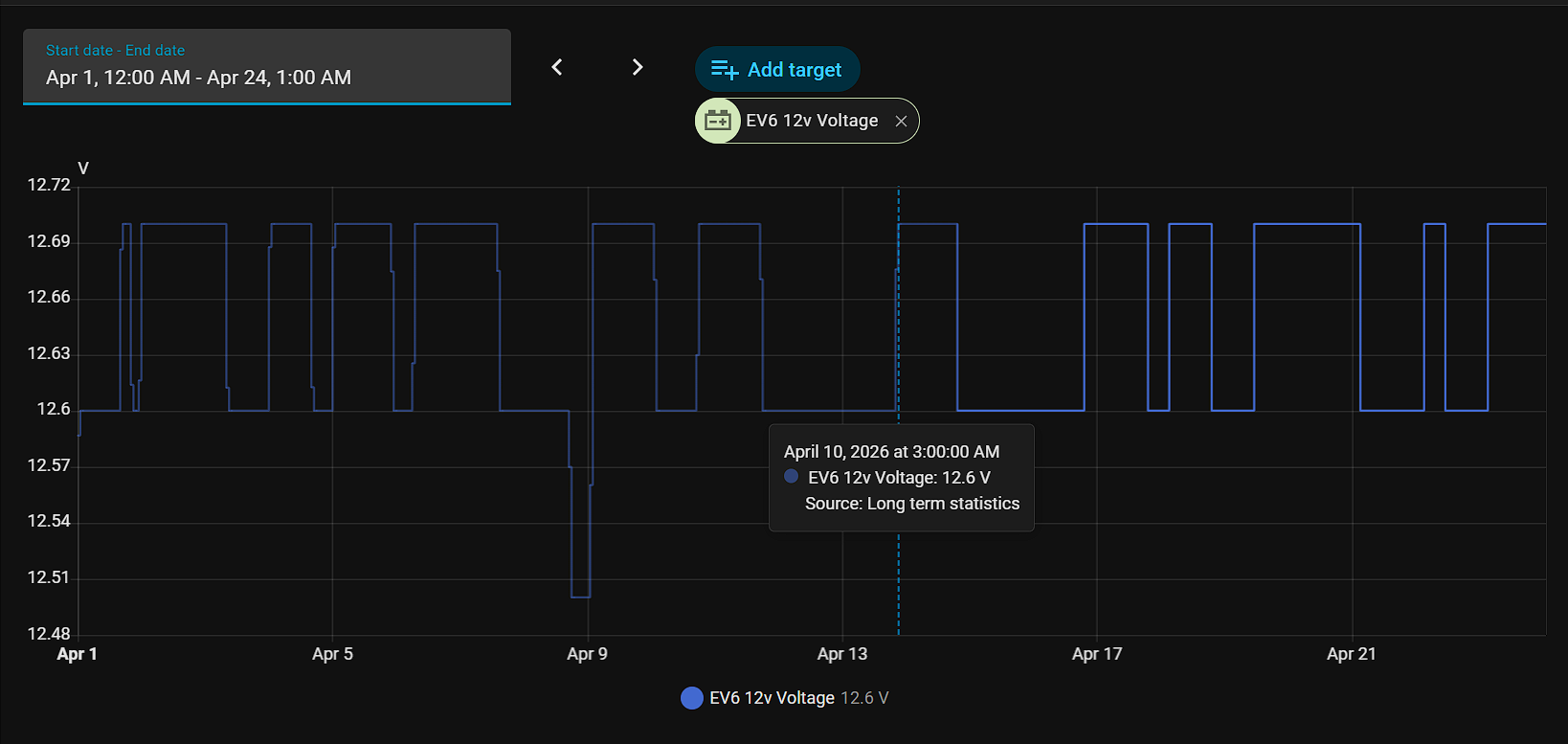
|
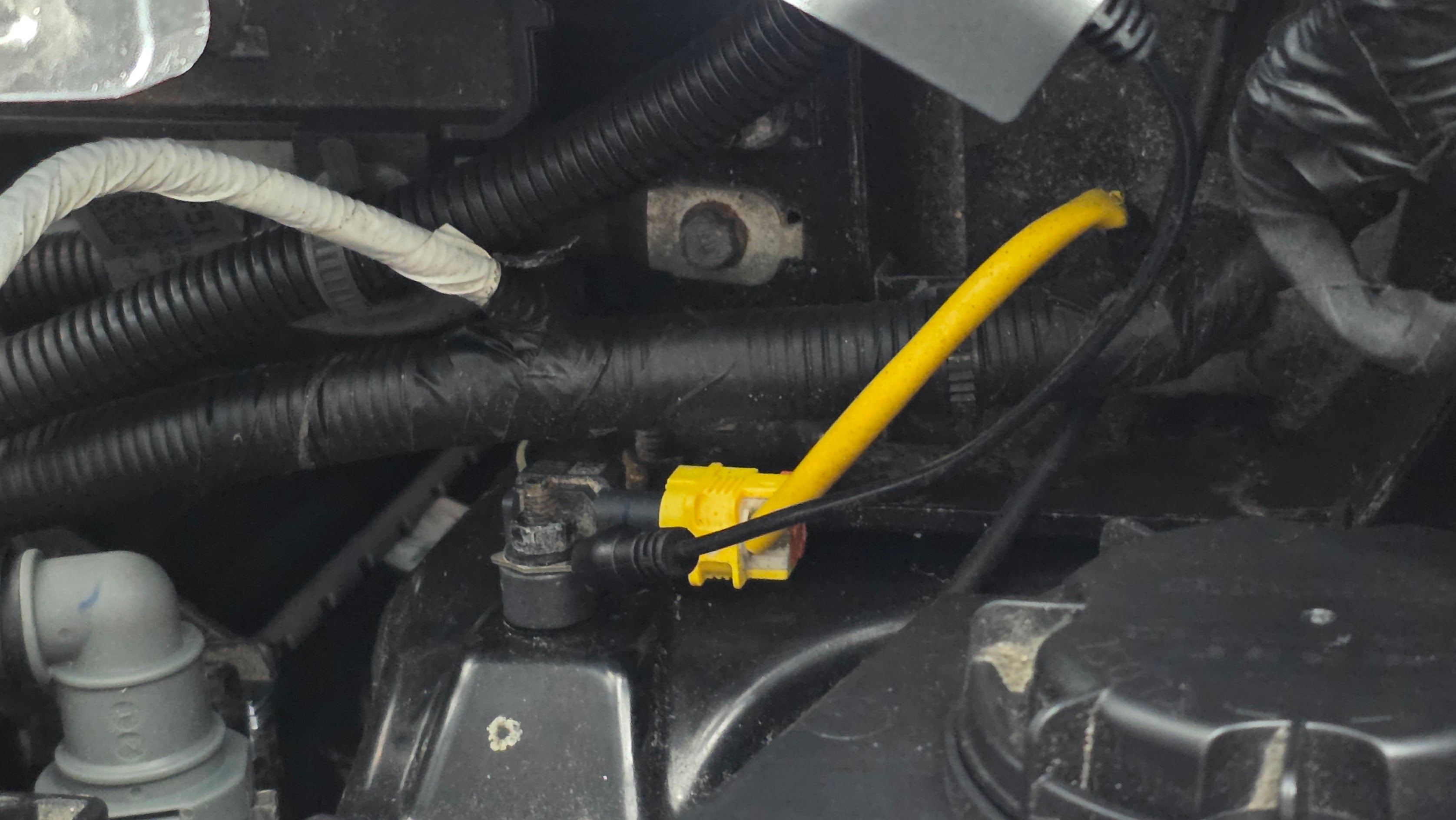
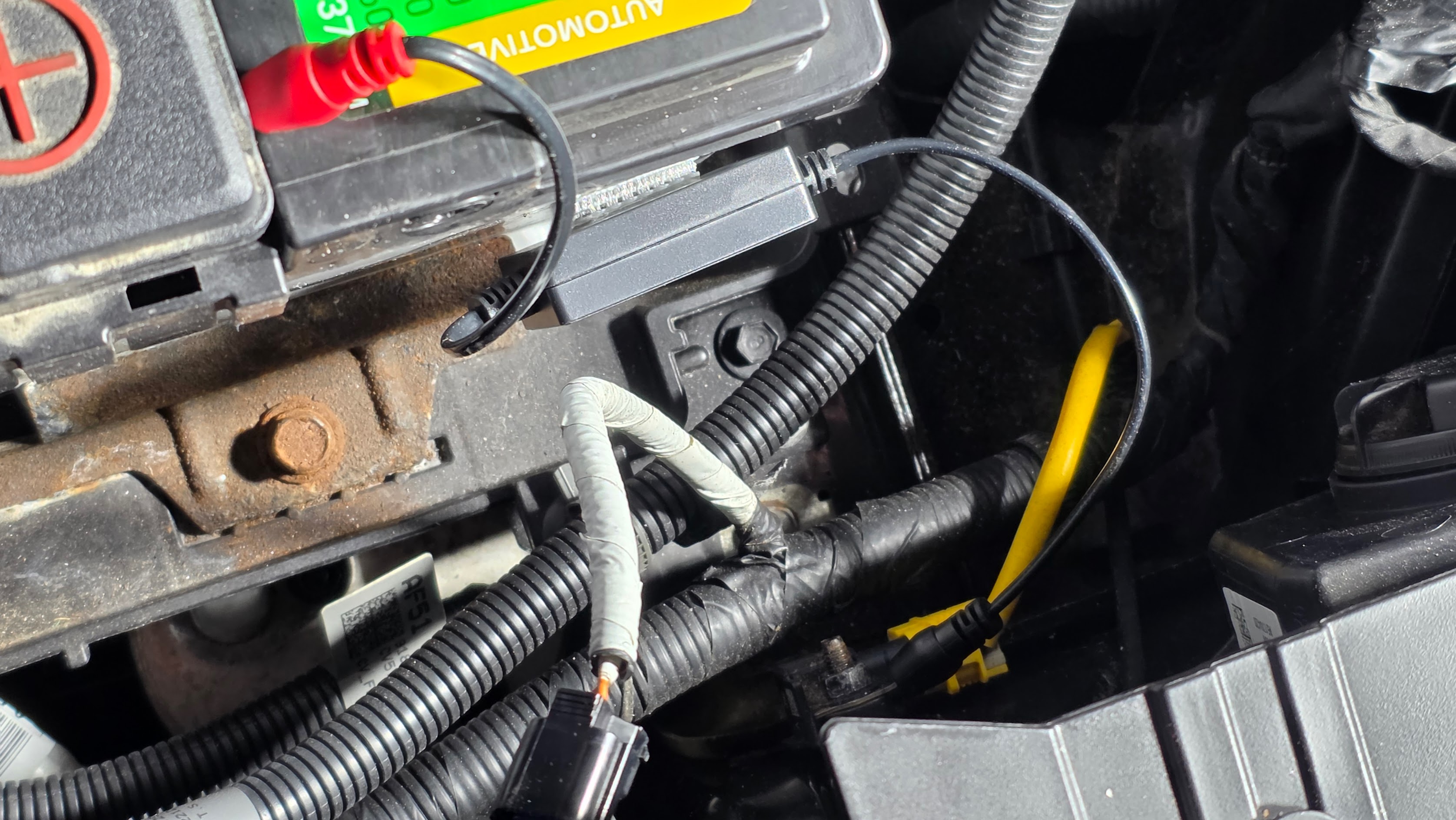
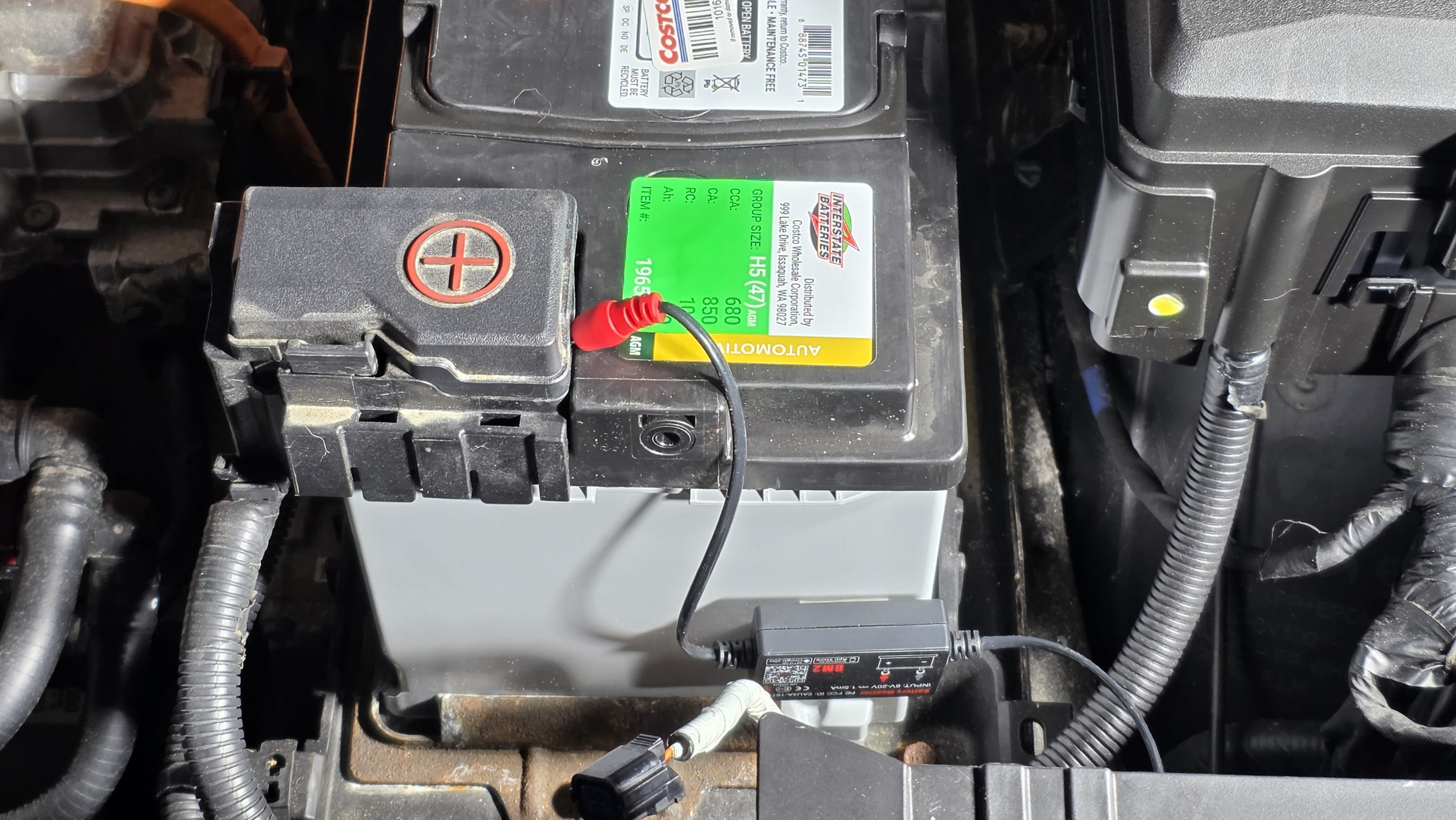
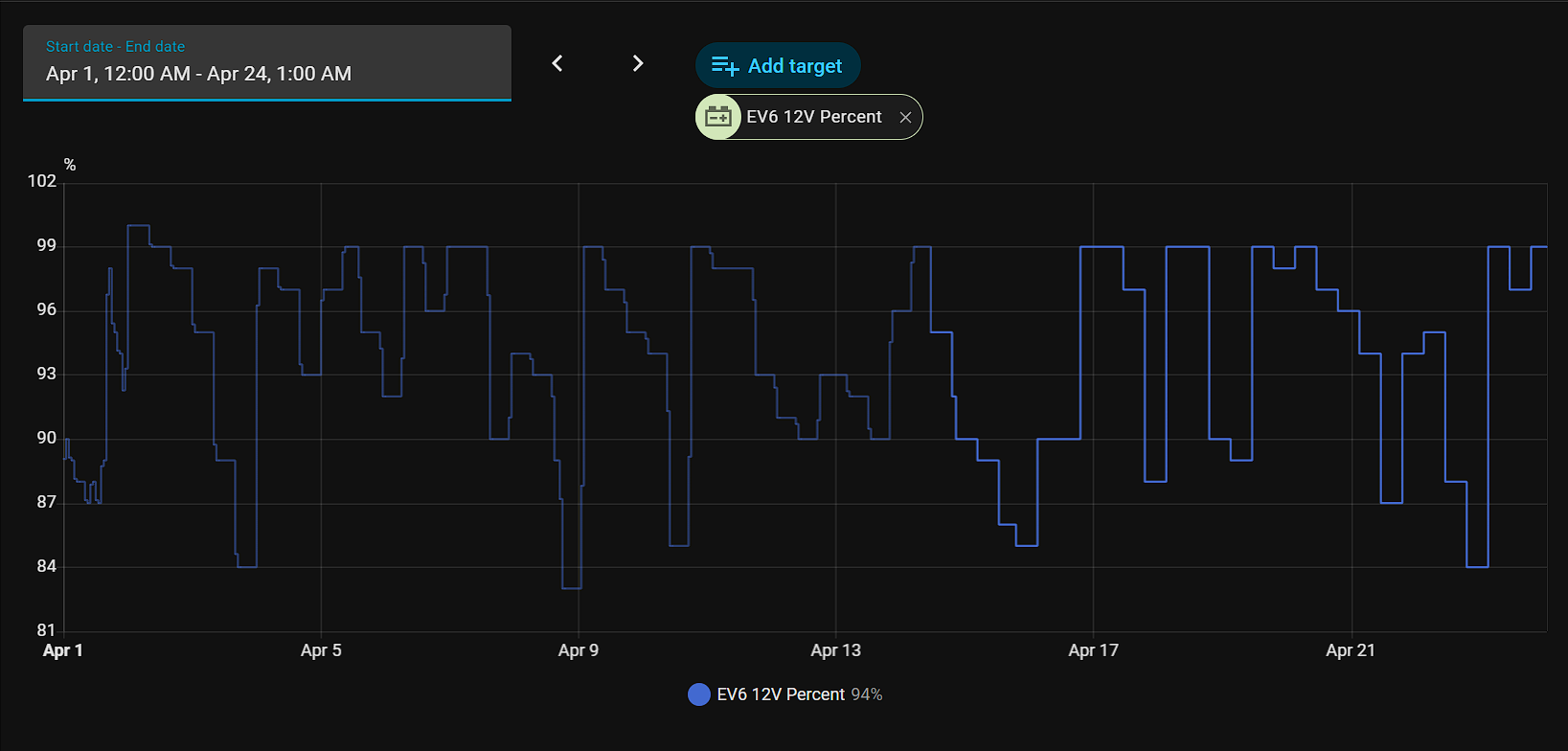
A Bluetooth battery monitor like the Battery Monitor BM2 (also sold under the Ancel BM300 name at a higher price – same device, different branding) gives you continuous visibility into your 12V battery's voltage, charge state, and charging patterns – without popping the hood. You'll see trends that would otherwise be invisible: gradual voltage decline, abnormal charge/discharge cycles, or the LDC struggling to maintain voltage. This is your early warning system – catching a tired 12V battery before it starts stressing the ICCU.
Installation note: A reader wrote in to point out that E-GMP models have an Intelligent Battery Sensor (IBS) mounted on the negative terminal – a shunt-based sensor that tracks all current flowing through it so the BMS and LDC can calibrate their charging strategy. Anything connected directly to the battery post bypasses the sensor and becomes invisible to the car. Therefore, the BM2's positive lead should be fastened under the nut on the positive terminal, while the negative lead should be connected to a chassis ground point – any unpainted bolt on the body or frame near the battery is fine (see installation photos). The BM2 draws so little current (~1 mA) that the practical impact of incorrect installation is negligible, but there's no reason to do it the wrong way when doing it the right way is just as easy. (This applies to all 12V accessories on IBS-equipped vehicles – manufacturers advise against connecting any device ground directly to the battery negative post. See this overview of how battery sensors work for more detail.) Alternately, if you have access to a Home Assistant server, you can sync up your Hyundai/Kia/Genesis app and grab the sensor data that way. The community-maintained ha_kia_hyundai_USA HACS integration (a USA-focused fork of the now-archived kia_uvo project) pulls 12V state-of-charge from your connected services account (along with HV battery state, charging status, location, tire pressures, and more), and presents an estimated 12V voltage derived from SOC. You can graph trends, set alerts, and tie it into automations – no hardware on the battery itself required. The “Force Update” command should be used sparingly, since each force-wake can drain the 12V battery and may trigger API rate limits. Also, remember to decrease the integration's polling (it defaults to ten minutes) to lighten the load on your 12V battery. I set mine up at 480 minutes. |
| 4. Keep the 12V battery healthy Primarily helps: LDC |
A healthy 12V battery reduces how often and how hard the LDC has to cycle – fewer on/off transients means slower MOSFET degradation. When it's time for replacement, an AGM battery is recommended. However, even AGM batteries need monitoring – one owner reported their 25-month-old Kia-branded AGM had degraded enough to trigger ICCU failure. Early warning signs of a tired 12V battery that's stressing the ICCU include: the yellow/orange dash charging indicator illuminating frequently or staying on constantly (even after 40+ minutes of driving), delayed response from power accessories (e.g., power seats not responding for 1–2 seconds after pressing the button), memory profile storage being lost, and 12V voltage reading around 12.1V or lower. These are signs your 12V battery needs attention. If the BM2 or another battery monitor flags declining health, replace the battery promptly with an AGM unit. When replacing, don't just swap it in a parking lot – there's a calibration procedure your car needs to properly manage the new battery.
A note on lithium 12V replacements: We're not recommending against lithium replacements – owners who use them generally report positive experiences. However, if you're considering one, it's worth reading this detailed analysis from an electrical engineer specializing in failure analysis, who observed unexpected LDC charging behavior after installing a lithium (LFP) unit. Batteries like the Ohmmu and similar EV-specific lithium replacements include a built-in BMS that's supposed to handle the chemistry difference, so it's not clear what caused the behavior he observed – but the thread is worth a read before making your choice. If your car came with a standard flooded lead-acid battery (common on 2022–early 2024 builds), upgrading to AGM is widely considered the best move in the community (see survey data) – the original flooded batteries were notorious for failing within 10–15 months, and Kia themselves switched to factory AGM starting around February 2024. Well-documented |
| 5. Don't AC charge immediately after hard driving in extreme heat Primarily helps: LDC OBC |
Let the thermal management system cool the ICCU before adding the additional heat load of AC charging. DC fast charging bypasses the ICCU, so this applies specifically to Level 1 and Level 2 charging. |
| 6. Use a quality EVSE (UL/CSA certified, hardwired preferred) Primarily helps: OBC |
Reduces AC power quality issues reaching the ICCU. A hardwired installation eliminates the plug connection as a potential source of resistance and heat. UL or CSA certification ensures the unit meets safety and electrical standards. |
| 7. Dedicated circuit for the EVSE Primarily helps: OBC |
Helps minimize voltage fluctuations from other household loads on the same circuit. |
| 8. Whole-house or EVSE surge protector Primarily helps: OBC |
Most Level 2 EVSEs include basic built-in surge protection, but it's limited in capacity – enough for minor grid transients, not a significant surge from a transformer fault or major grid event. It's also worth noting that in the case of an OBC failure, fault current can flow the other direction – from the car back through the EVSE – potentially tripping breakers or damaging the charging station. The 2020 National Electrical Code (NEC Article 230.67) requires a whole-house surge protective device (SPD) at the main service panel, but for additional protection closer to the EVSE, you can install a Type 2 SPD at the subpanel or disconnect feeding your charger circuit – a permanently installed device that clamps voltage spikes before they reach your EVSE. This layered approach isn't redundant – the whole-house SPD catches large surges at the service entrance, while the Type 2 SPD at the subpanel catches smaller transients that make it past. Whether it's strictly necessary beyond the whole-house SPD depends on your area – in regions with frequent outages or unstable grid, a dedicated EVSE SPD is cheap insurance ($250–500 installed) compared to the cost of ICCU or EVSE damage. Consult an electrician familiar with your local codes (licensed and insured, always, please). |
| 9. Avoid charging during storms or brownouts Primarily helps: OBC |
Grid instability creates exactly the kind of voltage spikes that stress the ICCU. |
| 10. Monitor LDC output via OBD tool Primarily helps: LDC |
Apps like Car Scanner can read LDC output voltage. Healthy while driving (car ON) is ~14.0–14.5V; at rest, ~12.4–12.8V is normal. |
| 11. If you endorse the humidity theory: enable Auto Defogging Primarily helps: LDC OBC |
If you endorse the humidity theory as a potential cause (see the humidity hypothesis discussion in Section 6), enable Auto Defogging to help keep the car interior humidity low, especially if carrying many passengers in colder or damp weather. On EV6 and Ioniq 5/6, it lives under Settings → Vehicle → Climate → Defog/Defrost Options → Auto defog, or hold the front windshield defroster button for 3 seconds while the car is ON. The windshield humidity sensor triggers the AC compressor (which dehumidifies as a side effect of cooling), switches to fresh air, and directs airflow to the windshield. Theory-dependent |
Editor's note: Hyundai Motor Group hasn't disclosed which – if any – of these practices are truly warranted. But if the MOSFETs really do fail in a death-by-a-thousand-cuts scenario – and the evidence strongly suggests they do – then implementing some of these suggestions may not prevent failure outright, but hopefully they extend the ICCU's life long enough for Hyundai Group to deliver a better part, which as of September 2026 still hasn't been confirmed one way or the other. Torque News has reported a call in which Hyundai corporate told an Ioniq owner that an upcoming reliability improvement is in the works, and informal mentions of a “more reliable” replacement part have surfaced in other owner channels. Whether that materializes – and what it actually changes about the ICCU – remains to be seen. It's also worth noting that ICCU failures aren't exclusive to 800V E-GMP vehicles – the 2023 Kia Niro EV, a 400V platform, has a documented NHTSA TSB for the same failure pattern. The underlying design vulnerability may be broader than voltage class alone.
In a similar vein, a reader has reported what appears to be an OBC-type failure on a 2025 Hyundai Tucson Plug-In Hybrid: dead 12V, dealer-confirmed OBC failure, fault code P1E01 – which is the parent of the OBC fault-code family used on E-GMP vehicles (P1E011C, P1E0211, P1E1300, P1E0C73 – see Section 4) – and the standard “something shorted inside” diagnostic. The Tucson PHEV charging module is a different part (36400-3DAJ6, rated for 7.2 kW vs. E-GMP's 10.9 kW), so whether this is the same root cause or a parallel failure mode in a different module isn't clear from one report. But the diagnostic schema and failure progression are notably similar to E-GMP OBC failures, and worth flagging as the data accumulates.
The class action lawsuit. In April 2026, a class action was filed in the U.S. District Court for the District of New Jersey: Young, et al., v. Hyundai Kefico, Inc. The central allegation is that Hyundai “replaced defective integrated charging control units with equally defective ICCUs,” and that the recall remedy hasn’t resolved the underlying problem. How much technical visibility this produces for the public is an open question – class actions like this usually settle before the expert reports and internal documents that would actually explain the defect become part of the public record. It's more likely to function as pressure on Hyundai Motor Group to expand coverage or accelerate a hardware fix than as a fact-finding exercise that finally tells us what's wrong with the ICCU. As of mid-September 2026 the docket shows only procedural activity: service in July, and two extensions of the defendant's deadline to answer, the latest granted September 10. Full details are on the news page.
Got a comment, more info, or a correction?
Email editor@egmpfiles.com10. Sources
NHTSA Recall Documentation
- NHTSA 24V-867 Part 573 Report – Kia EV6 ICCU Recall (SC327)
- NHTSA 24V-868 Part 573 Report – Hyundai ICCU Recall (identifies "MOSFET")
- NHTSA SC327 Recall Notification
- NHTSA RCRIT-24V867-0280 – Updated Remedy (Jan 15, 2026; revised ICCU part number on p.11)
- NHTSA RCRIT-24V867-6963 – Original Remedy (superseded)
International Coverage and Journalism
- Consumer Reports – Hyundai's and Kia's Charging Unit Issues Cause Problems for EV Owners (Feb 12, 2026) – Independent survey: 2–10% failure rate; Kia spokesperson confirms "thermal loading and transient high voltage"
- Auto Motor und Sport – Kia EV6 ICCU Defect, Swiss Accident, and German Recall Scope (Jan 2025)
Teardowns and Component Identification
- LTEC Corporation – ICCU Teardown Report (confirms STMicroelectronics SiC)
- GoingElectric.de – ICCU Teardown and ~300 Failure Analysis (identifies SCT1000N170)
SiC MOSFET Reliability Literature
- NIST/IEEE – SiC vs. Si Gate Oxide TDDB Comparison (2018)
- Ohio State – Vth Stability and Gate Oxide Screening Challenges in SiC MOSFETs
- PMC – 4H-SiC MOSFET Threshold Voltage Instability Under Stress
- NREL – Rds(on) and Vth Degradation Trends in SiC MOSFETs
- Power Electronics News – 1200V SiC MOSFET Short-Circuit Evaluation (2–4.5μs at 800V)
- EE Power – Reliable SiC Power Devices for Automotive Applications
Part Number Documentation
- iccu.observer – Known ICCU Part Numbers (community database, continuously updated)
- KiaEVForums – Dealer repair order confirming 36400-1XFA0AQQK + 375F2-GI040QQK (zaglaw95, Feb 1, 2026)
- KiaEVForums – Dealer confirms "would not recur" with new ICCU (zaglaw95, Jan 31, 2026)
- r/KiaEV6 – New 2025 ICCU Part Number 36400-1XFD6 (humanthrope, ~Feb 2, 2026)
Community and Journalism
- InsideEVs – Hyundai's ICCU Problem: Here's What We Know
- KiaEVForums – 12V Battery and ICCU Design Problem (LDC current behavior analysis)
- Cars.com – Genesis, Hyundai and Kia Charging Control Unit Recall Primer
- Drive Tesla Canada – Kia EV6 Under Investigation by Transport Canada
- KiaEVForums – ICCU Failure 250 Miles From Home
- KiaEVForums – The Dreaded ICCU Failure
- KiaEVForums – Second ICCU Failure in 18 Months
- KiaEVForums – Drive Mode Impacts ICCU 12V Battery Charging
- KiaEVForums – EV6 ICCU: Any Repeat Failures?
- KiaEVForums – ICCU Failures: How Do You Charge?
- KiaEVForums – Charging EV6 Knocked Out Power to House
- EVDANCE – ICCU Failure: Symptoms, Causes, Prevention
- KiaEVForums – A Different ICCU Failure (OBC failure mode, breaker tripping)
- KiaEVForums – Lev 1 and Lev 2 Charge Failure on 2023 EV6 Wind
- Hyundai Forums – ICCU Failure and Damage to External Switching Unit
- IoniqForum – Is the Replacement ICCU Any Better?
- BobIsTheOilGuy – Hyundai/Kia/Genesis ICCU Issues
This page is an independent community resource and is not affiliated with Kia, Hyundai, Genesis, or any manufacturer. Information is compiled from publicly available NHTSA filings, professional and community teardowns, peer-reviewed semiconductor reliability literature, and firsthand owner reports. Evidence strength is indicated throughout. Where claims go beyond what is officially documented, this is stated explicitly.